
Interactive Exercises
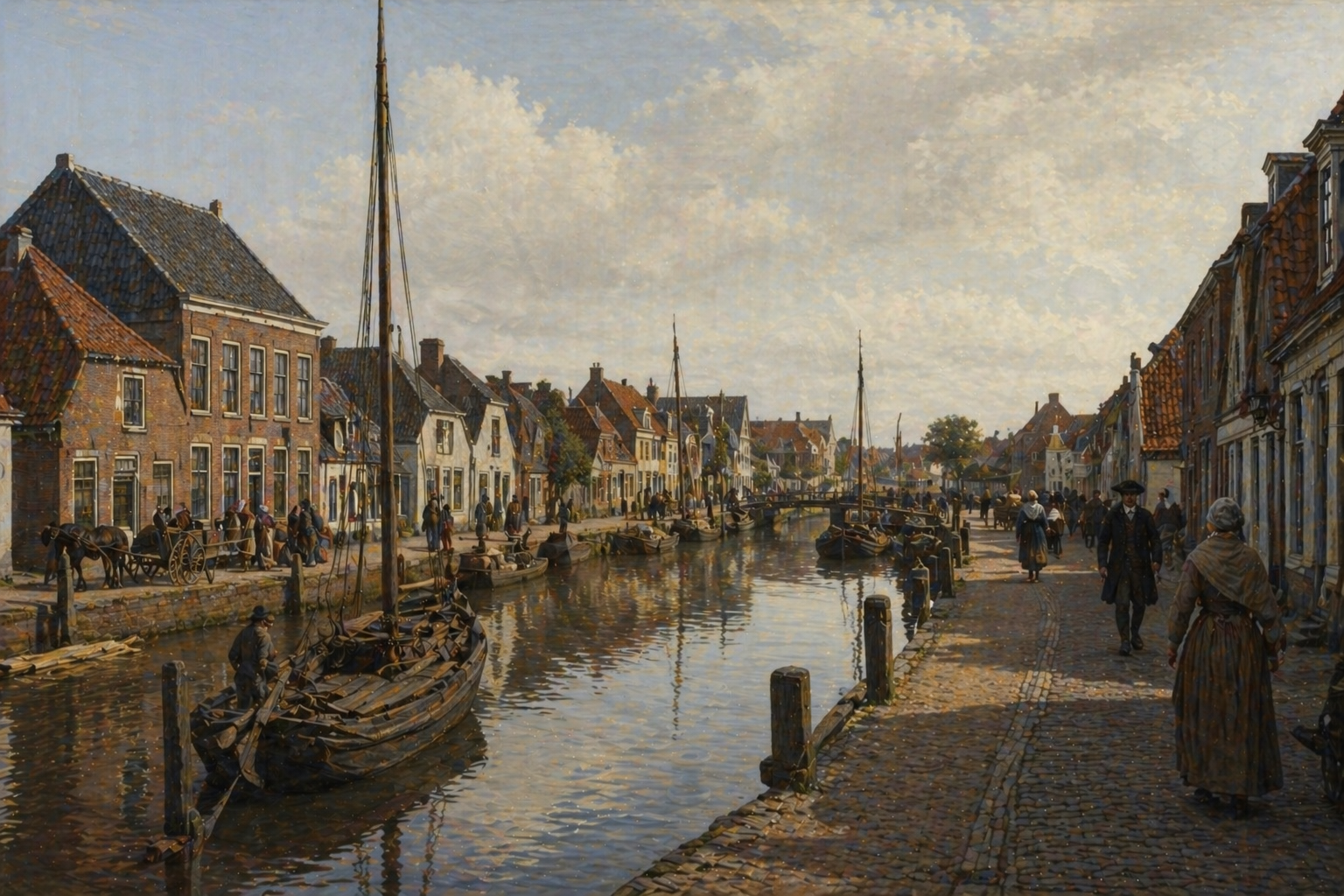
The Shipyard on the Ems · Band 1 · Papenburg, 1795–1804
35 chapters · three difficulty levels · instant feedback for B1 and B2 · model answers for C1
Select your level using the buttons at the top of each chapter. You can switch between levels freely — or work through all three on the same chapter.
Chapters marked New are additional editorial chapters (4b, 11b, 14b) not in the original publication.
A Note to the Reader
This is a work of historical fiction set in Papenburg, a small town in northern Germany, in the year 1795. The Meyer Shipyard — Meyer Werft in German — is real, founded exactly as described in these pages. All characters are fictional.
The people of Papenburg spoke Low German — Plattdeutsch — amongst themselves. This story is told in English, but you will encounter occasional Low German phrases where they belong to the atmosphere. They are always explained.
Each chapter is followed by vocabulary, language notes, and discussion questions. The vocabulary is aimed at B2–C1 level English learners — real, literary English worth knowing.
The Boy at the Canal
He stands at the edge of the yard and does not go in.
It is the hammering that stops him. Not because it is unexpected — he has walked past this place a dozen times in the past month, has heard the noise growing day by day as the new shipyard took shape along the main canal. No. It is the scale of it. He had imagined something smaller. Something more forgiving.
His heart is beating faster than he would like.
Go in, he tells himself. You are sixteen years old and this is just a yard full of wood and men with tools. Go in.
He goes in.
He had risen before four. Pulled on his trousers, then the old wool pullover that had belonged to his father — too large, smelling of smoke, but warm. In the kitchen, the peat embers were still glowing. He heated yesterday’s porridge and ate it standing up, directly from the pot. It tasted of nothing in particular. But it was warm and it would last.
His mother had not stirred. He was glad of it. He did not want to be seen off at the door like a child on his first day at school. This was different. This was work.
The walk from their house to the shipyard took twenty minutes along the main canal. In the darkness and fog, Papenburg was a town of sounds rather than sights: the creak of ice along the banks, the faint smell of bread from the baker’s house, the soft lap of water beneath the frozen surface. He had walked this path so many times that he knew every stone of it. That, at least, was familiar. Everything else was new.
Peat. His father’s entire life had been peat. Johann Janssen spent twenty years cutting it from the moor behind the town — every morning up before dawn, every evening back with blackened hands and a modest wage. Enough to live on. Nothing more. Harm had watched him do it for as long as he could remember. He had watched the way the work wore at a man, year by year — bent the back, coarsened the skin, reduced everything to the simple animal rhythm of rising and working and sleeping and rising again.
That will not be my life, Harm had thought, many times. Not the moor. Not the peat.
He was not certain, yet, what his life would be instead. But the Meyer Shipyard was a beginning.
The Meyer Shipyard, Papenburg · 1795
The Meyer Werft was founded on 28 January 1795 by Willm Rolf Meyer on the main canal of Papenburg, a small town in the Emsland region of Lower Saxony, Germany. The yard initially built small coastal vessels suited to the shallow waterways of the North Sea coast. Meyer was not the first shipbuilder in Papenburg, nor the only one — but he proved to be the most determined. Today, almost two and a half centuries later, the Meyer Werft remains one of the most celebrated shipyards in the world, famous above all for its enormous cruise ships. It is still in the same town, on the same river.
A man walked towards him from across the yard — perhaps fifty, tall, with a grey beard and the kind of stillness that comes from decades of work rather than any natural calm. His eyes met Harm’s directly. Not warm. Not hostile. Simply: assessing.
“You’re the Janssen boy.” It was not a question.
“Yes. Harm Janssen.”
“Roelfs. Foreman.” A pause that lasted precisely as long as it needed to. “Your father spoke to me. He says you work hard.”
Harm did not know what to say to this, so he said nothing.
Roelfs looked at him for a moment longer. Whatever he concluded, he kept to himself. He turned. “Come.”
The yard was larger than Harm had imagined. Roelfs walked him through it without hurrying: the timber store, the tool racks, the open area towards the canal where the keel would be laid — the very spine of the first ship, the foundation on which everything else would depend. Harm listened and tried to hold it all in his head. There was too much. He knew, distantly, that in a month he would know this yard as well as his own kitchen. But right now it was bewildering, and he was careful not to show it.
“You start by carrying timber today. Planks from the store to the carpenters. Set them down where you’re told. Ask if you don’t understand. Don’t talk too much.”
“Yes.”
“That is Tammen.” Roelfs nodded towards an older man working nearby — so still and concentrated over his work that Harm had not noticed him until now. “Oldest carpenter here. Any question you have when I’m not available, you take to him.”
Tammen glanced up briefly. His face was deeply lined, weathered to the colour of old oak. His hands — resting on a plane — were extraordinarily large, the knuckles thickened by decades of work. He nodded once, without expression, and returned to what he was doing. Harm had the feeling, obscure but distinct, that this was a man worth paying attention to.
The first day was simply hard. The planks were heavy and wet. After an hour his arms ached steadily. After two, his back joined in. He said nothing and kept moving — from the timber store to the carpenters and back, over and over, in a rhythm that was mercifully too demanding to leave room for thought.
At midday the men ate. Harm sat slightly apart with his bread and looked out over the canal. The ice had thinned in places. Dark water showed through beneath it — very still, very cold.
He thought of his father. Of the blackened hands. Of the modest wage.
And then — unexpectedly, with the particular vividness of things glimpsed and half-forgotten — he thought of something else.
On the way to the yard this morning, just before he reached the gate, he had seen a girl standing at the canal bank. She was there for only a moment before the fog took her again — a dark coat, a basket on her arm, her face turned towards the water. She had not looked at him. He was not sure she had known he was there at all.
But he still saw her. The stillness of her. The way she stood.
He shook his head and tore off another piece of bread. Foolishness. He did not know her. In all likelihood he would never see her again.
Roelfs called out. The break was over.
Harm stood, took the next plank, and carried on.
By the time the day ended and Roelfs said “same time tomorrow,” Harm’s hands were raw and his shoulders burning. He walked home along the canal. The fog had thickened again with the cold of evening. Papenburg was quiet. His body ached in ways he had not yet found names for.
Near the baker’s house he stopped. Not because he had meant to — his feet simply slowed and then halted. He was standing at the spot where the girl had been that morning. There was nothing there now, of course. Only the ice, and the dark water beneath it, and the fog moving slowly over both.
He stood there a moment, long enough to feel slightly foolish about it, and then walked on.
What he did not know — what he could not yet know — was everything else.
Vocabulary — Chapter 1
Level B2–C1 · Literary EnglishLanguage Notes — Chapter 1
For Discussion · Chapter 1
- The chapter opens not with Harm waking up, but with him already standing at the gate, unable to enter. Why is this a more effective beginning? What does it tell us about him before we even know his name?
- Harm describes his father’s life in detail — the blackened hands, the modest wage, the wearing rhythm of physical work. He says “that will not be my life.” Is he being ambitious, or is he being unkind to his father’s memory? Or both?
- Roelfs says almost nothing. And yet we form a very clear picture of him. How does the author achieve this? What specific details create the impression?
- The girl at the canal appears twice — morning and evening — without a word or a name. Why do you think she stays in Harm’s mind? And why do you think the author refuses to tell us more about her at this point?
- The final sentence is: “What he did not know — what he could not yet know — was everything else.” What do you think “everything else” will turn out to mean?
The Author’s Choice — Chapter 1
What Roelfs Sees
I was up at four, as always. Bread, cold water, out the door. The walk to the yard takes ten minutes. In summer it is pleasant. In January it is simply a walk.
Thirty years in the shipbuilding trade. First in Leer, then Emden, now here in Papenburg. I was an apprentice myself once — sixteen, thin, convinced I knew more than anyone around me. That was a mistake. But it is the kind of mistake one must make for oneself.
The boy arrives just after five. Earlier than I expected.
I see him from across the yard: a slight young man with an oversized cap and shoes too thin for the weather. He does not hesitate at the gate — that is good. He walks directly, but he is also looking, taking it in. That is better. Many boys arrive with their eyes fixed ahead, seeing nothing. This one sees.
I know his father. Johann Janssen, peat cutter. A quiet man, honest, works without complaint. He came to me three days ago and asked whether his son might start at the yard. He did not plead. He simply asked, and waited.
I said yes because I trust the father. But that is not sufficient reason, on its own. The son must show what he is.
He looks at me directly. Not impudent — but not cowed either. That is the right balance. I have seen boys who cannot hold my gaze at all, and boys who meet it with something close to defiance. Neither is what I want. This one simply looks, as though eye contact is entirely natural. Which it should be.
I take him round the yard and tell him what he needs to know for today, and nothing more. Then he starts carrying planks.
I watch him without letting him see that I am watching. After an hour it is clear: he is not strong. But he does not give up. In my experience, endurance matters more than strength. Strength comes with time and work. Endurance — you either have it or you don’t.
I notice his hands. He is holding the planks correctly — using the whole body, not the arms alone. Nobody showed him this. He worked it out himself in the first hour. That is a good sign.
Sitting on a timber stack at midday, I look out over the canal and think about the larger situation. The times are uncertain. The war in Europe is disrupting trade. Meyer has two commissions for this year — two small coastal vessels. That is enough to keep the men paid. Not more.
I have been here before. In 1789, in Emden, when the upheavals in France began and merchants turned cautious. Orders dried up. A yard closed. I lost my position.
I do not intend to let that happen again.
In the evening I tell the boy: “Same time tomorrow.” He says “Yes.” Nothing more is necessary.
I walk home. My wife has made soup. I eat, say little, think about the next day.
The Janssen boy will carry planks again tomorrow. And at some point he will carry something else — if he is clever, if he stays. I have been wrong before. I may be wrong now.
But I do not think I am.
Vocabulary — Chapter 2
Level B2–C1 · Narration and ObservationLanguage Notes — Chapter 2
For Discussion · Chapter 2
- We see the same first day from Roelfs’ perspective. What does he notice that Harm doesn’t know is being noticed? Does it change your picture of that morning?
- Roelfs says he “may be wrong” about the boy — but clearly doesn’t believe it. What does this kind of cautious self-correction tell us about him as a character?
- Roelfs mentions the war and the uncertainty of trade. This is the first time politics enters the story. Why do you think the author introduces it through Roelfs rather than through Harm?
What Wood Knows
After a week, Harm knows three things with certainty: the yard smells different in the morning than it does at dusk. Roelfs never speaks more than is needed. And Tammen is the most intelligent man he has ever encountered.
The last of these took him several days to understand. At first, Tammen appeared to be simply an old man who worked slowly and said nothing. But Harm began to look more carefully. Tammen’s hands never moved without purpose. Every cut of the plane was placed exactly where it needed to be. And every plank he touched, he held briefly to his ear — and listened. As though the wood were telling him something that only he could hear.
On the fifth day, Harm asked him. “Why do you do that? The listening?”
Tammen looked at him — a long, considering look, as though deciding whether the question merited an answer. Then: “Damp wood sounds dull. Dry wood sounds clear. A ship built from damp wood will split within two years. So one listens.”
That was all. Tammen returned to his work. Harm thought about it for the rest of the day.
On the sixth day something small happened that Harm did not forget.
He carried a plank to Tammen’s workstation — one of the planks that had been left out in the rain the night before, the timber store being inadequately covered. He set it down. Tammen picked it up, held it briefly to his ear, and put it aside.
“Wet.”
“I know. It rained last night. The store—”
“I know it rained.” Tammen was already reaching for the plank. “Bring me one from the back of the store. The roof is better there.”
Harm went. He brought a dry plank. Tammen listened, nodded, and began.
Then, without looking up: “You didn’t argue.”
“What?”
“Most boys would argue. Would say: but it is only a little wet. Or: all the planks are like that.” Tammen kept working. “You went and brought another one.”
A pause. The plane moved steadily along the grain.
“That is correct,” said Tammen.
In the evening, Harm sat alone at the canal. The fog had thinned a little. He watched the dark water. He thought about what Tammen had said — not the praise, which had been brief enough to be almost nothing, but the principle beneath it. The plank was wet. The argument that it was only a little wet, or that all the others were the same, was perfectly logical. And completely beside the point. The point was: Tammen needed a dry plank. Everything else was noise.
Wood is not simply wood. That was Tammen’s first lesson. And Harm was beginning to suspect that it applied to more than timber.
Vocabulary — Chapter 3
Level B2–C1 · Craft and ObservationFor Discussion · Chapter 3
- Tammen teaches by showing and by silence — he almost never explains directly. Is this a good way to teach? What kind of learning does it produce?
- Harm concludes: “Wood is not simply wood — and the same applies to more than timber.” What do you think he means? What else in his life might this principle apply to?
- Why do you think the author chose carpentry — a craft of close attention and listening — as the trade at the centre of this story?
The First Mistake
It happens on a Tuesday, in the third week. Harm is carrying a heavy oak plank — nearly three metres, heavier than anything he has handled so far. He has picked it up badly, and he knows it within ten steps. But he does not want to go back and start again. That would be weakness, he thinks. So he carries on.
He is almost there when his foot catches in a dip in the ground. It happens very fast: he stumbles, the plank tips, he loses it. The wood falls — and strikes Peters across the shoulder.
Peters does not shout. He makes only a short, sharp sound — the sound of a man who has absorbed a sudden blow and is deciding, very quickly, how badly he is hurt. Then he stands very still, his hand at his shoulder.
Everything on the yard stops for a moment.
Harm stands with empty hands, the plank on the ground. His face is hot. He cannot find anything to say.
Roelfs is there immediately. He examines the shoulder with the brisk efficiency of a man who has dealt with injuries before. “Nothing broken. But you are done for today.”
Peters nods. He glances at Harm — not with anger, not with contempt. Only a long, tired look. Then he walks to the edge of the yard and sits down.
Roelfs turns to Harm. He does not speak straight away.
“If a plank is too heavy,” he says at last, “you say so. You ask for help. That is not weakness. That is good sense.” A pause. “Understood?”
“Yes.”
“Good.” He showed Harm then — without impatience, precisely — how to carry a long plank alone: how to use the body’s weight, how to place the feet. It took five minutes. “Now you.”
Harm picked the plank up correctly this time. He carried it to Tammen. He set it down. Nobody said anything. Work resumed.
But the shame stayed with him all day.
At midday he went to Peters. The old man was sitting at the edge of the yard, eating bread with his good hand.
“I’m sorry. I should have asked for help.”
Peters chewed and swallowed. “I know.” A silence. “I did the same. My first month. Dropped an axe. Hit no one — fortunately.” He looked out over the canal. “You learn. Or you don’t.”
He said nothing more. Harm nodded and went back to work.
That night he lay awake. He thought: I wanted to appear strong, and I hurt someone. That is not strength. It is stupidity. And then: should I go back tomorrow?
He lay with this for a long time. Then he turned onto his side.
Yes. He would go back. Not because it was easy. Because it was right.
In the morning he put on his father’s pullover and opened the door.
He was someone who had made a mistake. Who had spent a night with it. And who came back anyway.
Perhaps that was not so different from everyone else. But it was something.
Vocabulary — Chapter 4
Level B2–C1 · Error and ConsequenceFor Discussion · Chapter 4
- Harm makes the mistake because he doesn’t want to appear weak. Do you think this kind of pride is universal? Have you ever made something worse by trying to manage it alone?
- Peters’ response — “You learn. Or you don’t” — is strikingly simple. Is it kind, or cold? Or is it something harder to define?
- The chapter ends: “He was someone who had made a mistake. Who had spent a night with it. And who came back anyway.” Why is coming back, in itself, an act of character?
What He Said to Gerd
It is Thursday. Two days since the plank, and things at the yard have settled. Peters is back — his shoulder stiff but working, and he has said nothing more about the incident. Harm has been careful, very careful, since then. He carries less than he can manage. He asks Roelfs before he moves anything heavy.
It is Gerd who causes the trouble.
Gerd is sixteen, like Harm, but from Leer — the son of a shipwright there, sent to Papenburg to learn from Tammen. He has been at the yard three months longer than Harm, and he lets this be known. Not loudly. But consistently. The way he hands Harm tools — slightly too late. The way he answers Harm’s questions — slightly too briefly. The way he moves in front of him when Roelfs is watching.
Harm has noticed this. He has said nothing, because he knows he is the newer man, because he knows Gerd is better than him at three things at least, and because he also knows that complaining would be far worse than enduring.
But on Thursday, at midday, when they are sitting together eating bread on the timber stack, Gerd says something.
They are talking about the keel — about how long it will take to build the first ship, about what kind of vessel it will be. Harm has heard from Peters that it will be a Mutte, a flat-bottomed cargo vessel for the peat trade. Gerd has heard from Tammen that it will be larger than that.
“Tammen told me,” Gerd says. He says it with particular emphasis. Tammen told me. Not: I heard. Not: they say. Tammen told me. Privately. As though Tammen and he have conversations.
Harm looks at the canal. He eats his bread.
“He doesn’t say much, Tammen,” Harm says carefully.
“Not to everyone,” says Gerd.
A pause. Harm can feel the silence arranging itself into a shape. He knows what the shape is: Gerd is saying that Tammen speaks to him, specifically. That Harm is not included. That there is a difference between them that the three months of seniority justifies and always will.
He thinks: let it go. It is bread and cold air and a Tuesday in February. This means nothing. Let it go.
He doesn’t let it go.
“The thing is,” Harm says, “when someone tells you something, it usually means they think you need telling. Tammen hasn’t had to tell me anything yet.”
The silence that follows is of a different quality than the one before. Gerd looks at him — a flat, assessing look that Harm recognises as the moment before a decision is made. Then Gerd picks up his bread, stands up, and walks away.
He does not speak to Harm for the rest of the day.
That afternoon Roelfs comes to where Harm is working — smoothing a plank, a task that requires concentration, and which Harm has been grateful for today. Roelfs does not say anything at first. He watches Harm work for a while.
“What happened between you and Gerd at midday?” he asks.
Harm keeps the plane moving. “Nothing. A small argument.”
“About what?”
“About what Tammen says and to whom.”
Roelfs makes a sound that is not quite approval and not quite criticism. Then: “Was it worth it?”
Harm thinks about this honestly. “No,” he says.
“Then next time,” Roelfs says, “eat your bread.”
He walks away. Harm keeps working.
It takes a week. Gerd thaws slowly — first speaking again in practical matters only, then, gradually, in something approaching normalcy. By the following Thursday they are working side by side on the second rib and Gerd hands him a chisel without hesitation, and Harm takes it without comment, and neither of them mentions what was said.
But Harm does not forget what Roelfs told him.
Was it worth it?
He had said no because it was true. It was not worth it. He had said something sharp to prove something small, and he had damaged something that he needed — a working relationship, the goodwill of the only other boy on the yard — for the satisfaction of a moment.
He is sixteen. He will do this again. He knows this about himself, now, in a way he didn’t before.
But he also knows what Roelfs will say.
And that is worth something too.
Vocabulary — Chapter 4b
Level B2–C1 · Conflict and PrideFor Discussion · Chapter 4b
- Harm can see exactly what Gerd is doing — he identifies the “shape” of the manipulation — and says something sharp anyway. Have you ever done this? Is self-awareness always enough to stop a bad decision?
- Roelfs asks only one question: “Was it worth it?” Why is this more effective than a lecture? What does it say about his approach to teaching?
- The chapter ends: “He is sixteen. He will do this again.” This is unusual — the narrator predicting a flaw that won’t be fixed. What does this admission do for our trust in the story?
- Gerd is described neutrally — not as a villain, not as wrong. He is simply older, more established, and using that advantage. Is this fair or unfair behaviour? Where is the line?
Gerd’s version of the same Thursday
Write the scene from Gerd’s point of view. He is not a villain — he has his own reasons for the way he behaves. What is he actually thinking when he says “Not to everyone”? What does he want?
Suggested length: 200–300 words · First or third person · Use at least 3 vocabulary items from this chapter
The Smell of the Town
Harm is up at half past four every morning. He sleeps in a small room off the kitchen — no window, barely space for the bed. In winter it is cold enough that his breath shows in the air when he wakes.
He dresses quickly: rough wool trousers, the long stockings his mother knitted, the heavy shoes. His father’s pullover. His cap. In the kitchen the peat embers are still warm. He reheats yesterday’s porridge and eats standing up, directly from the pot. He has stopped noticing the taste.
The walk to the yard takes twenty minutes. He knows it now at every hour and in every weather. In fog, in frost, in the brief hard daylight of January afternoons. He knows every stone, every slippery patch, every place where the ice comes first.
Papenburg wakes slowly at this hour.
At the baker’s — the Oltmanns house, three minutes from home — there is already the smell of bread: heavy and warm, hanging in the cold air like something solid. Further on: woodsmoke from a chimney. Then the canal — dark, quiet, with a faint creaking where the ice still holds. And far ahead, barely audible, the first hammering of the yard.
Past Peters’ house. Past Frericks’ shop — flour, salt, dried fish, tar soap, open from seven but with a lamp already burning in the back room. Past the church, its tower only an outline in the mist.
And then the yard.
Today something is different. Roelfs is not at the gate. He is standing in the middle of the yard with Tammen and two other carpenters, all of them looking down at something on the ground — something long, enormous, that Harm has not seen before.
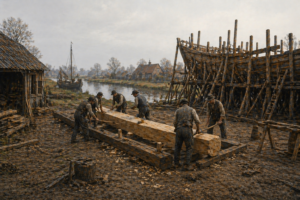
A timber beam. A single oak beam, nearly ten metres long and as thick as Harm’s thigh, dark with age and oil. It rests on wooden supports, raised half a metre off the ground. The men stand around it with the particular stillness of people contemplating something significant.
Gerd comes up beside him. “The keel,” he says quietly.
“What?”
“The keel. The beginning of the ship. They’re laying it today.”
The keel is the lowest and longest timber in a wooden ship — the backbone, running from bow to stern. Everything else is built upon it: the ribs, the planking, the mast. A good keel must be made from a single piece of oak, because oak does not rot in water. Shipbuilders used to say: whoever lays the keel lays the ship’s fate.
Roelfs gives a brief signal. Four men step forward and lift the beam — slowly, almost soundlessly, with the concentrated effort of men who understand exactly what they are carrying. Only the groan of the timber, the steady breathing of the men.
They carry the keel to its position. Lower it. It lands with a single dull sound. The men step back.
No one speaks.
Then Tammen nods — once, briefly — and the work begins.
At supper his mother had made soup — cabbage, a little smoked bacon, water. Dark rye bread on the side. They ate without speaking, as they usually did.
“They laid the keel today,” Harm said.
His mother nodded. She had grown up in Papenburg. She knew what a keel was.
“Then it’s really beginning,” she said.
“Yes,” Harm said. He broke off a piece of bread. “Then it’s really beginning.”
Vocabulary — Chapter 5
Level B2–C1 · Place and BeginningFor Discussion · Chapter 5
- The author describes Harm’s daily walk in detail — the smells, the sounds, the cold. Why does this kind of sensory description matter in a historical novel? What does it give the reader?
- The laying of the keel is treated as a solemn, almost ceremonial moment — and yet very little is said. How does silence function in this chapter?
- “Then it’s really beginning.” These words close the chapter. Who is speaking — Harm, his mother, or both? What are each of them thinking when they say it?
Sunday
On Sundays, Harm sleeps until half past six. This is a luxury he has come to value enormously, in the way that only those who rise before dawn on every other day can truly understand what sleeping past five means.
There is porridge with a spoonful of syrup. That is Sunday. A small difference that stands for everything.
At nine they walk to church — his mother in her best dress, dark blue, somewhat worn but clean and pressed. Harm in his Sunday shirt, which has grown too tight across the shoulders. Neither of them mentions it. They walk together along the canal, through the morning mist.
After church, the market.
The market square lies along the main canal — perhaps twenty stalls, some under canvas, some just a table with goods laid out. Eels from the Ems, silver-bright and gleaming on a wet cloth. Turnips and cabbage. Coarse linen in dark blue and brown. An old man with hard yellow cheese that smells of cellars. Everywhere voices: vendors calling, women bargaining, children running, dogs barking. The smell of wet stone, of fish, of peat.
His mother buys turnips, a piece of cheese, a handful of dried peas. She counts the coins twice before she hands them over. Harm carries the basket.
He watches the other people. The poor women who count their coins, just like his mother. And then, on the far side of the market, the others — merchant wives in better clothes, accompanied by a maid who carries the basket. They do not bargain. They point to what they want and the maid pays.
Harm looks briefly at one such family. A man in a good coat with a fur collar — a merchant, he guesses. A wife. And behind them, a girl in Harm’s age, holding a basket of fresh herbs and staring away at something in the opposite direction with the frank boredom of someone who has stood through too many market mornings.
He looks away. His mother is calling. They go home.
In the afternoon, Harm whittles at the canal. A small piece of timber from the yard, a scrap. He makes nothing in particular — just moves the knife and watches the water.
He thinks about the yard. About the keel, lying in its position. About Tammen. About Roelfs.
Tomorrow is Monday. He is looking forward to it.
This surprises him slightly. But it is true.
Vocabulary — Chapter 6
Level B2–C1 · Social ObservationFor Discussion · Chapter 6
- Harm observes the class difference between the women who count coins and those who don’t. He notices it without anger or bitterness. What does this tell us about him at this point in the story?
- The girl at the market — bored, staring away — is a brief, vivid glimpse. Do you think this is the same girl from the canal? What might connect these two moments?
- The chapter ends: “Tomorrow is Monday. He is looking forward to it.” Given everything we know about his days — the cold, the aching back, the weight of the planks — why does this sentence feel important?
A Name in the Fog
Harm has still not properly seen Herr Meyer. Once, in the third week, he glimpsed a figure at the edge of the yard — a man in a dark coat who stopped, looked, and walked away. Roelfs had glanced up briefly and returned to his work without comment. That was all.
The men speak of Meyer occasionally. Not much. But enough.
“Meyer has been making enquiries in Leer,” Peters says one afternoon. “About oak. From the east.”
“That’s expensive,” says Gerd.
“He wants good timber,” says Tammen, without looking up. “Cheap timber makes poor ships.”
Harm listens. He thinks: Meyer is thinking years ahead. He is not building for this season. He is building for twenty years from now.
That afternoon, something unusual happens.
Harm is carrying tools from the store to the workshop when he hears a voice from the far side of the yard — calm, clear, accustomed to being heard without needing to raise itself. He turns.
A man is standing at the edge of the yard. Perhaps fifty. Medium build. A good coat, not ostentatious. He is looking at the work in progress with the measured attention of someone who owns everything he is looking at.
Harm knows immediately who this is. The way Roelfs straightens almost imperceptibly. The way Tammen slows without stopping. The way the yard continues to work and yet does not quite continue to work. This is Herr Meyer.
Meyer glances in Harm’s direction. Their eyes meet for perhaps half a second — long enough for Harm to feel, inexplicably, that he is being assessed and simultaneously dismissed. Not unkindly. Simply: this man has more important things to look at than a young carpenter with a load of planks. Then Meyer looks away — across the yard, across the keel, across the first ribs beginning to rise from it. He speaks briefly to Roelfs, too quietly for Harm to catch. Roelfs nods. Meyer leaves.
No one remarks on it. Work continues.
Harm returns to his task. He drives a nail into a plank. Then another.
Behind him, he hears Roelfs and Tammen speaking — very quietly, not intending to be overheard. He does not turn round. But he hears two words.
“Dirksen,” says Roelfs. Almost a whisper.
And then, after a pause, Tammen’s voice: “Be careful.”
The men part. Work goes on.
Harm drives another nail. He thinks: who is Dirksen? He does not ask. It is not the moment for that.
But he does not forget the name.
Vocabulary — Chapter 7
Level B2–C1 · Power and ObservationFor Discussion · Chapter 7
- Meyer appears but says almost nothing. How does the author make him impressive without describing him impressively?
- “Dirksen. Be careful.” Two words, overheard. The chapter refuses to explain. Why is this more effective than an explanation would be?
- Harm is already learning to observe and to wait. How is he different at the end of Chapter 7 from the boy who stood at the gate in Chapter 1?
The Girl at the Canal
It is a Tuesday evening in April. The days are lengthening. By the time Harm leaves the yard, there is still a pale grey light over the canals — not warmth exactly, but the memory of warmth, hanging in the air before the cold reasserts itself.
He is walking home. He is tired. His back aches, as it always does by evening. He is thinking about supper.
Then he sees her.
She is standing at the canal bank, perhaps twenty metres ahead. Alone. She is about his age. A dark wool coat, dark brown hair pinned back. A small basket over her arm. She is looking at the water.
He stops walking.
He is not entirely sure why. She is doing nothing remarkable — simply standing at the canal, looking at the water, the way people do. But there is something about the way she stands — entirely still, entirely self-contained, as though the water is saying something that only she can hear — that makes him stop and remain stopped.
The light is pale and soft. The canal barely moves. She looks at the water. He looks at her. Three seconds, perhaps four. Then he hears footsteps behind him — someone coming along the path — and he walks on.
He does not turn back.
At home there is soup. He eats. He gives a brief account of the day when his mother asks. He goes to bed early.
But he does not fall asleep immediately.
He thinks about her. Not for long — or perhaps for a long time; he loses track. He thinks about the stillness of her. The way she stood at the water as though she belonged there in a way that most people do not belong anywhere.
Who is that? he thinks. And then: It doesn’t concern you. You don’t know her.
Then he sleeps.
The next morning he takes the same path. Of course she is not there — it is half past four in the morning and no one is at the canal. He does not expect her to be there. He does not even look, particularly.
But as he passes the spot, he slows for half a step. Just that.
Then the yard is in sight, the hammering begins, and he goes in.
Vocabulary — Chapter 8
Level B2–C1 · Impression and RestraintFor Discussion · Chapter 8
- This is the third time we have seen this girl — once in the fog, once at the market, now here. Each time she is unaware of being observed. What is the author building? What do these brief glimpses give us that a direct introduction would not?
- Harm tells himself: “It doesn’t concern you.” Do you believe him? What does this kind of self-command reveal?
- The chapter ends not with a dramatic moment but with Harm slowing his step — “just that.” Why is this small, involuntary detail more powerful than anything he might have said or done deliberately?
Mette’s World
I stand at the canal most evenings. Father doesn’t know, or perhaps he does and says nothing, knowing I’ll go anyway. I slip out after supper while Lisbeth washes the dishes and Father sits in his study going over the accounts. Ten minutes. Sometimes fifteen. I need it.
It is the only time of day when I am alone.
Our house stands directly on the main canal — a two-storey half-timbered building with glazed windows facing the street. Below: the shop and Father’s study. Above: the kitchen, the sitting room, my parents’ bedroom, my room, and Lisbeth’s small chamber. Lisbeth is our maid.
The house is warm. That is not a given. Father says this sometimes. “The Janssens heat with peat. We heat with wood.” He does not say it unkindly. It is simply a fact to him. I sometimes wonder what it feels like to sit in a house warmed by peat. Whether it smells different. Whether warmth is different when it costs more to produce.
This evening I am standing at the canal with my basket of herbs — I forgot to buy them this morning and went back later — when I hear footsteps on the path behind me. I don’t turn round. It would be improper. Workers going home from the yard, usually. I recognise them by their walk: heavy, steady, the walk of men who have been on their feet since before dawn.
Then the footsteps stop.
Someone has halted, just there, on the path behind me. I don’t know why. I go on looking at the canal. After a few seconds the footsteps continue. I pick up my basket and go indoors.
I never know who that was.
At supper, Father speaks about the new shipyard. He often does these days.
“Meyer is building faster than I expected. The keel has been down for weeks. At this rate he’ll have a finished vessel by autumn.”
“Is that good for us?” my mother asks.
“It could be. Shipbuilders need tar, rope, tools. I already supply some of it. If the yard grows, so does the demand.” He drinks his tea — proper tea, from a tin that came from Leer, expensive, we have it every evening. “Meyer is a careful man. I’ve spoken to him. He thinks long term.”
Long term. All the men say this. Father thinks long term too — about his shop, his suppliers, his connections. And about my marriage.
I eat and say nothing. That is my role at supper: to listen, not to disrupt. But I do listen. Always.
In the morning I am up at seven. Breakfast: tea, white bread with butter and honey. My mother is already sewing — she sews every morning, before anything else. At half past eight I go downstairs to help in the shop. I am learning the accounts — prices, weights, quantities. A merchant’s daughter must be able to calculate, Father says. He is right. But he does not say for what purpose, since I will not run a shop. I will marry.
I stand at the window sometimes before the first customers arrive. The men have long since gone to the yard — hours before I wake. I see only their backs, if I am early enough. Men in old coats, walking with purpose into the dark.
I find myself thinking about their mornings. What they eat. Where they sleep. Whether they are ever so tired that they stop thinking entirely. I am never that tired. My life is not hard. I know that. It is not a complaint.
But sometimes I think: is this all there is? White bread and tea and sewing and waiting to be told whom I am going to marry?
Then I look out at the canal. That helps, a little.
Lisbeth calls. The first customer is here.
I step back from the window. I smile. I help.
That is my day.
Vocabulary — Chapter 9
Level B2–C1 · Voice and ConstraintLanguage Notes — Chapter 9
For Discussion · Chapter 9
- We have just experienced the same Tuesday evening from two perspectives — Harm’s (Chapter 8) and Mette’s (Chapter 9). What does each of them notice? What do they have in common that neither of them knows?
- Mette says: “I will not run a shop. I will marry.” She states this without apparent emotion. Do you read this as acceptance, resignation, or something more complicated?
- Both Harm and Mette ask themselves a version of the same question: is this all there is? In what ways are their situations similar — and in what ways are they completely different?
- Mette ends her chapter: “I smile. I help. That is my day.” Compare this to how Harm ends his chapters. What does this difference in register and tone tell you about each character?
The Author’s Choice — Chapter 9
Mette and Her Father
It is a May evening. After supper, Father stays at the table instead of going to his study. This is unusual. I clear the dishes. My mother goes to the bedroom. Lisbeth washes up.
“Sit down, Mette.”
I sit.
He drinks his tea. He does not speak immediately — he never does, when he has something important to say. He thinks first.
“You are sixteen,” he says at last. “Seventeen in the autumn.”
“Yes, Father.”
“It is time to begin thinking.” He does not look at me. “About your future.”
I know what he means.
“I have spoken to some men. In Leer. In Emden. Nothing is decided. But I want you to know that I am thinking about it.”
“Yes, Father.”
“You are intelligent, Mette. More so than most.” He puts down his cup. “But intelligence alone is not sufficient. You need a sound man. One who can provide properly.”
“Do you have questions?” he says, after a moment.
I have many questions. I ask none of them.
“No, Father.”
He nods and goes to his study. I remain at the table.
Through the window I can see the canal — dark and still. A barge is moving slowly, laden with something, heading towards the Ems. It goes where it is pointed. Or where the current takes it.
I get up and help Lisbeth with the last of the dishes. The water is cold. I wash them anyway.
Vocabulary — Chapter 9b
Level B2–C1 · Restraint and SubtextFor Discussion · Chapter 9b
- Mette’s father speaks to her about her future without once using the word “marriage.” Why? And what does this kind of indirect speech tell us about the relationship between them?
- The barge at the end — “it goes where it is pointed. Or where the current takes it.” Is Mette comparing herself to the barge? Is it hopeful, resigned, or simply observational?
- The cold water in the last line — “I wash them anyway” — is such a small detail. But it carries something. What?
What Roelfs Says
It is the end of April. Harm has been at the yard for nearly three months. Three months — that sounds like very little. But it feels like half a lifetime. He knows every corner of the place now. Every man’s name. The rhythm of the work — the quiet hours of early morning, the louder hours at midday, the tired hours of late afternoon when the ache has settled deep into the bones and the last hour feels longer than all the others combined.
The ship is growing. The keel has been in place for weeks — solid, dark, a fixed point in the middle of the yard. From it, the ribs are now rising: curved oak timbers, one after another, on both sides, like the bones of a great animal slowly assembling itself. The shape of the thing is becoming visible. Not yet a ship — not planked, not masted — but unmistakably the skeleton of one.
On a Tuesday evening, after the others have gone, Roelfs says: “Stay a moment.”
Harm stays. Roelfs walks over slowly — he always moves slowly, as though every step is deliberate — and comes to stand beside him. He looks at the half-finished ship without saying anything.
A long silence.
“I have seen many apprentices in thirty years,” Roelfs says at last. “Some of them stronger than you. Some cleverer.” A pause. “Most of them left.”
“Why are you telling me this?”
“Because you ask. Most of them don’t. They wait to be told what they are.” He looks at the ship. “That is not nothing.”
“I made a mistake. With Peters.”
“Yes. And you came back. That is worth more than making no mistake.”
A silence. The canal makes a quiet sound. Somewhere in the town a dog barks.
“The yard swallows many of them,” Roelfs says then. “Some it spits back out. Some — some stay.” A beat. “I think you will stay.”
Harm does not know what to say. So he says nothing.
Roelfs nods — the short, conclusive nod that Harm has come to know — and walks away.
Harm stands alone in the yard. The unfinished ship in front of him. The evening light.
He thinks I will stay, Harm thinks. He’s right.
He walks home. The path along the canal is entirely familiar to him now — every stone, every bend. He stops for a moment at the place where the girl sometimes stood. The water is there. The ice is long gone. The canal moves quietly in the evening light.
The Ems flows somewhere beyond the canals — slow, dark, patient. It has been flowing since before Papenburg existed. It will be flowing long after this evening is forgotten.
It is a strange thought. But not an unpleasant one.
Vocabulary — Chapter 10
Level B2–C1 · Recognition and PermanenceFor Discussion · Chapter 10 · End of Act I
- Roelfs tells Harm he will stay. Harm thinks: “He’s right.” This is a moment of recognition — but both men keep it very contained. What does this restraint tell us about the culture of the yard? About these two men?
- Act I ends with Harm standing at the canal, thinking about the river’s permanence. What does this ending suggest about what Harm is beginning to understand about his own life?
- Look back at Chapter 1. Harm stood at the gate and almost didn’t go in. Now he stands at the canal knowing, without any doubt, that he belongs. What has changed — and what has stayed the same?
Winter at the Yard
In November, the freeze comes properly. The ground is hard as stone. The men’s breath rises white in the air. The tools are so cold that bare hands cannot hold them for long. But the work continues. Roelfs says nothing about the cold. So no one else does either.
Harm has changed. He can feel it, in the incremental way that real changes always announce themselves — not suddenly, but as a series of small recognitions. His arms are stronger. His hands have developed calluses — hard, numb patches on the palms where at first the wood blistered the skin. He sleeps better. He eats more. He thinks less.
That last one surprises him. He used to think a great deal — about the future, about his father, about what kind of life he was going to make. Now he thinks about timber. About tools. About the next task. He is not sure whether this is a loss or a kind of peace. Perhaps both.
The hammering sounds different in the cold — sharper, more crystalline, like something being struck in ice. The smell of timber and pitch mingles with frost and wet stone. The fingers go numb and one claps them together, breathes on them, carries on. At midday there is hot water and bread. It tastes better than anything Harm has ever eaten.
In December, the Ems freezes over. This is a problem: timber deliveries come by water, and water does not move when it is ice. Roelfs has the men sort and stack the existing supplies. It will last some weeks. Perhaps not the whole winter.
Harm overhears Roelfs and Tammen speaking. He does not catch everything, but he hears the word “spring.” Which means: waiting. Which means: patience.
He is learning patience. It is perhaps the hardest thing so far.
On a Sunday in December, he walks out onto the frozen canal. It holds. He moves to the middle — to the place where the barges pass in summer — and stands there. Beneath his feet: dark ice. Beneath the ice: the water he cannot see but knows is there.
He looks in both directions. The canal in the town, and the canal beyond it, stretching away into the moor.
This is Papenburg, he thinks. My town.
He has never been more certain of anything.
Vocabulary — Chapter 11
Level B2–C1 · Endurance and ChangeFor Discussion · Chapter 11
- Harm observes that he thinks less than he used to. He wonders if this is “a loss or a kind of peace. Perhaps both.” What do you think? Is the capacity to stop thinking about the future a sign of contentment, or of something being suppressed?
- Standing on the frozen canal, Harm thinks: My town. This is the first time he has used that possessive with such certainty. What does it mean to belong to a place?
The Thing Between Klaas and Bert
It starts with a chisel.
Klaas is a day worker — thirty-something, dark-bearded, with hands the size of mauls and a temper that everyone knows about and nobody mentions. He has been at the yard since summer: reliable, strong, poor with precise work, excellent at the heavy tasks that the permanent men don’t have time for.
Bert is different. Bert is young — twenty or so — a carpenter’s son from Emden, on his second placement. He is good with his hands and he knows it, and he is the kind of man who finds it difficult not to point this out. Quietly. In the way of suggestions, improvements, observations. If you hold it like this. If you use the other side. If you—
The chisel is Klaas’s. Bert has borrowed it without asking. This has happened before.
Harm is nearby when it erupts. He is working on the inside of the second rib — a task that requires concentration, his body folded into the curve of the timber — when he hears Klaas’s voice rise from ordinary loudness to something sharper and then, very quickly, to something that is not a voice at all but a sound, a warning sound, the kind that precedes a physical decision.
He straightens. Across the yard: Klaas is standing very still, holding his chisel. Bert is a step away, also still, his jaw set. Neither of them is moving. This is often, Harm has learned, the most dangerous moment — the moment just before.
What he does next surprises him.
He steps between them.
Not because he has thought about it. Not because he has decided it is right, or because he is brave. His feet simply carry him there, into the gap between Klaas and Bert, and he stands facing Klaas with the feeling that he may have made a very serious mistake.
Klaas looks at him. The look lasts a long time.
“Move,” says Klaas.
“The rib,” Harm says. His voice comes out steadier than he feels. “Roelfs needs it by noon. We’re behind.”
A silence. The yard has gone quiet. Harm is aware of everyone watching.
Klaas looks at him for another long moment. Something in his face moves — not softening exactly, but shifting. He looks past Harm at Bert, and whatever he was about to say or do, he takes it somewhere else. He turns and walks to the far end of the yard.
Harm turns to Bert. “Give him his tools back before you use them,” he says quietly. “Ask first.”
Bert’s jaw tightens. But he nods.
Roelfs says nothing to him that day. But at the end of the afternoon, when the other men are cleaning up and Harm is putting away the planing tools, Roelfs comes past and slows — not stopping, not quite looking at him — and says, so quietly Harm almost doesn’t catch it:
“Good.”
And walks on.
Klaas does not thank him. This is fine. Harm did not do it for that. He is not entirely sure why he did it — it was not courage, he is fairly certain of that, because he felt no particular courage, only the strange compulsion of a body that knew what to do before the head did.
Bert avoids him for a week, which is also fine. On the eighth day Bert asks if Harm has a spare chisel — his has a crack in the handle — and Harm lends him one without comment, and the thing is, in some quiet way, over.
But Klaas looks at him differently after that. Not with warmth — Klaas is not a warm man. But when Harm is near, he pays attention in a way he didn’t before. He passes tools across without being asked. He moves to give Harm room.
It is a small thing. Harm files it away.
On a yard, small things add up.
Vocabulary — Chapter 11b
Level B2–C1 · Physical Tension and Quiet ResolutionFor Discussion · Chapter 11b
- Harm steps between two men without deciding to — “his feet simply carry him there.” Do you think true courage is always a conscious choice, or can it be something more instinctive?
- Roelfs says only “Good” — one word, almost inaudibly, while passing. Why is this more powerful than praise?
- Bert is the one who “borrows” the chisel — the trigger of the conflict — but Klaas is the one who nearly becomes violent. Where does the real problem lie? Is Bert wrong, or just oblivious?
- The chapter ends: “On a yard, small things add up.” What small things have added up in this novel so far? Make a list. What are they building towards?
Klaas’s point of view
Write a paragraph or two from Klaas’s perspective. He is a day worker — no security, no permanent position. The chisel is not just a tool; it is something else. What is it? Why does this particular thing matter so much?
Suggested length: 150–250 words · Focus on what the stolen object represents, not just what it is
The First Plank
With spring comes the timber. The Ems opens. The first barges arrive — oak beams from the east, pine from the north. The yard fills with the smell of fresh-cut wood again, the smell of something beginning.
Harm has been at the yard for nearly a year. He is no longer simply a plank-carrier. He holds tools, fastens smaller parts, measures and marks. Roelfs gives him more, gradually, without announcement.
One Tuesday morning, Tammen comes to him. This is itself unusual — Tammen does not come to people; people come to Tammen.
“Take that one,” Tammen says, indicating an oak plank. “Bring it over. And then cut it to size. I’ll show you how.”
Tammen teaches as he always does — almost entirely without words. He demonstrates. He adjusts Harm’s hands without explanation. He shows, not once but several times, how the cut must come from the shoulder, not the wrist.
Harm cuts.
The first cut is too deep — half a hand’s width off. He sees it immediately. He looks at Tammen.
Tammen looks at the plank. A long pause. “Again.”
Harm takes a new plank. He cuts. This time it is right.
Tammen nods. Once. That is all.
Harm sets the finished plank aside. He looks at it — a simple piece of shaped timber. Nothing remarkable about it, to any observer. But he made it. With these hands, with this tool, with this cut. It is his first plank.
He picks up the next one and begins.
Vocabulary — Chapter 12
Level B2–C1 · Craft and PrecisionFor Discussion · Chapter 12
- The first plank is “nothing remarkable to any observer.” And yet the moment clearly matters enormously to Harm. Why do private milestones often matter more than public ones?
- Tammen never praises directly — he simply says “again” when something is wrong, and nods once when it is right. Is this a good teaching method? What does it teach beyond the craft itself?
What a Ship Carries
In summer, the yard is a different place. Long days, light until eight in the evening. The men work longer and talk more. Sometimes someone sings — an old Low German song that Harm does not know but quickly learns.
The hull is almost fully planked now. From the side, it already looks like a ship — a long, curved form that has grown from the timber the way something living grows. Harm finds this astonishing every time. He knows rationally that men built it, plank by plank, nail by nail, day by day. But the effect is of something that emerged.
One quiet afternoon, Tammen sits down beside him on a timber stack. This is so unusual that Harm almost says something about it. He does not.
“Do you know where it is going?” Tammen asks.
“No.”
“Groningen, maybe. Or Hamburg. Or Emden. The merchants decide, not us.” A pause. “We build it. We don’t know what it sees.”
Harm thinks about this. The ship that his hands helped to build will sail somewhere he has never been. It will see storms, strange harbours, people he will never meet. The thought is odd. And somehow wonderful.
“Has it ever bothered you?” Harm asks. “Not knowing where it goes?”
Tammen thinks for a long time — long enough that Harm thinks he won’t answer. Then: “No. My work is the building. The sailing is someone else’s work.” He stands. “Everyone does their part.”
He goes back to work. Harm stays a moment.
Everyone does their part. It sounds simple. He suspects it takes years to actually understand.
Vocabulary — Chapter 13
Level B2–C1 · Work and MeaningFor Discussion · Chapter 13
- Tammen says: “We build it. We don’t know what it sees.” Does not knowing where your work goes make it more meaningful, or less? How do you feel about work whose outcome you can’t observe?
- “Everyone does their part” — Tammen treats this as a complete and satisfying answer. Harm suspects it takes years to understand. What do you think it means? And do you agree that it takes years?
Mette — A Name
It is Sunday. We go to the market. My mother, Lisbeth, and I. The summer is warmer than usual. The women at the stalls have red faces.
I buy a handful of strawberries — ripe, red, gleaming in the sun. That much I allow myself.
Then I hear Frau Oltmanns, the baker’s wife, talking to another woman nearby. I am not listening, not particularly. But then I hear a name.
“The Janssen boy. From the yard.” Frau Oltmanns sounds approving. “Roelfs has taken him on as a proper carpenter now. After only a year. That is fast.” A pause. “A quiet boy. But a hard worker.”
The other woman says something I don’t catch. They move away.
I stand with my strawberries and think: Janssen.
I don’t know anyone called Janssen personally. But I remember the evening at the canal — the footsteps that stopped behind me, that spring. I never knew whose they were. Now, perhaps, I do. Or perhaps not. Papenburg has many people.
But I think about it. On the walk home. At lunch. In the afternoon while I am sewing.
A quiet boy. But a hard worker. I don’t know him. I haven’t properly seen him. And yet he has a name now, where before he had none.
A name is more than nothing.
I eat my strawberries and tell no one what I am thinking. I usually don’t.
Vocabulary — Chapter 14
Level B2–C1 · Thought and RestraintFor Discussion · Chapter 14
- Mette now knows Harm’s name, without having met him. Harm does not know Mette’s name at all. What does this asymmetry suggest about how information moves through a small town?
- “A name is more than nothing.” What does Mette mean? What does a name give you that a nameless stranger does not?
What Father Has Decided
He tells me after supper, while Lisbeth is clearing the table and my mother is folding her napkin in her particular careful way that means she already knows.
My mother already knows. I see it in the fold.
“Alderts has spoken to me,” my father says. He sets his cup down. “Jan Alderts, from the cloth trade. You know the family.”
I know the family. Jan Alderts is twenty-nine. He lost his first wife two years ago — fever, in July. He has a house on the north canal, a warehouse, two workers. He is prosperous. He is not unkind, from what I have observed. He laughed at something at the Becker wedding last autumn, a real laugh, so there is that.
“He is interested,” my father says. He does not look at me when he says it. He looks at the window. “I told him he may call.”
The fold in my mother’s napkin. The window. The cup.
I say: “When did you decide this?”
“It isn’t decided. He may call.” A pause. “But I think well of him. And you are seventeen. It is time to think about these things.”
I go to my room. I sit on the edge of my bed in the dark — I do not light a candle — and I try to decide what I feel.
It is not simple.
I am not being sold, I know that. I know that my father is not cruel, that Alderts is not a bad man, that this is how it is done and has always been done and that most of the girls I know are already or nearly already in the same situation. I know that the alternative — refusing, waiting, deciding for myself — is not something that exists for a merchant’s daughter in Papenburg in 1796. It simply does not exist. I have understood this for years.
But knowing a cage is reasonable does not mean you want to be inside it.
Later, much later, when the house is quiet, I go to the kitchen. I pour water. I stand at the window that faces the canal.
I think: Alderts. Jan Alderts. The laugh at the Becker wedding. The house on the north canal. Two years a widower.
I think: who else knows his wife’s name? The one who died? I don’t. I have never heard it. She was there and then she was gone and no one mentions her now. That is the future that is also possible — to be the woman whose name nobody later knows.
I am not going to cry. That is a decision I have made very deliberately.
But I stand at the window for a long time.
In the morning I come downstairs and help Lisbeth with breakfast. My father sits at the table with his accounts. He glances up when I come in.
He looks, I think, slightly guilty. He is not a cruel man. He genuinely believes he is doing the right thing. He loves me, in his way — in the way of a man who has never thought very hard about what loving a daughter might require of him beyond keeping her fed and safe and correctly placed.
“Mette,” he says.
“Good morning, Father.”
I set the bread on the table. I pour his coffee. I sit down across from him and open my hands in my lap and look at them for a moment.
Then I look up. “When will he call?”
My father’s face settles with something like relief — the relief of a man who worried his daughter might make things difficult. “Next Sunday, perhaps. After church.”
“Good,” I say.
I eat my bread. I help Lisbeth. I go to the shop and count the bolts of linen and write the numbers in the ledger in my careful hand.
I smile. I help.
That is my day.
But in the ledger, where no one will look, in the margin beside the column of numbers — I write one word. Small. In the corner.
No.
I don’t know yet what it means. I don’t know what I intend to do with it. I may do nothing at all. Probably I will do nothing at all.
But it is there. It is mine. And for now, it is enough.
Vocabulary — Chapter 14b
Level B2–C1 · Agency, Constraint, and ResistanceFor Discussion · Chapter 14b
- “My mother already knows. I see it in the fold.” The mother knows and says nothing. Is she complicit? Powerless? Both? What would it take to have spoken?
- Mette describes Alderts fairly — noting his real laugh, calling him prosperous but “not unkind.” She is not making him a villain. Why is this more devastating than if he were simply unpleasant?
- “Knowing a cage is reasonable does not mean you want to be inside it.” Can you think of modern situations where this sentence would still apply? What has changed since 1796 — and what hasn’t?
- The hidden “No” in the ledger. What does this act mean? Is it enough? Is it a beginning, or just a consolation?
Option B — Comparison essay (advanced)
“Harm and Mette are both trapped — but by completely different things.” Write a short essay (400–500 words) comparing the constraints each character faces. Use evidence from at least three chapters for each character. Consider: what choices does each have? What would it cost to refuse?
400–500 words · Formal register · Use vocabulary from both this chapter and earlier chapters
The Rumour
It begins on a Monday, at the midday break. Gerd has news — from his mother’s brother, who trades in Leer. “French soldiers,” he says quietly. “In the Rheiderland. The border is close.”
The men eat and say nothing. Peters stops chewing for a moment, then continues. Tammen does not look up.
“The Peace of Basel,” says Roelfs. He is leaning against a timber stack, looking at the canal. “Prussia and France. April 1795. We are neutral.”
“For now,” says Gerd.
Silence. A bird calls somewhere.
“Dat blift so,” says Peters, and takes another bite of bread.
Low German: That stays as it is. Peters’ way of saying: there is nothing more to discuss.
The men stand up. The break is over.
But Gerd says one more thing, lower, more for Harm than the others. “There’s something else. About Dirksen.”
Harm looks at him. “What?”
“He has debts. Significant ones. A supplier in Emden hasn’t been paid. Dirksen has no commissions left — they’ve all gone to Meyer. To us.” He glances across the yard. “They say he’ll lose the yard by spring, if nothing changes.”
Harm says nothing. He thinks of the name he overheard, months ago — spoken quietly between Roelfs and Tammen. Dirksen. Be careful.
“And?” Harm says at last.
Gerd shrugs. “I’m just saying. A man who loses everything—” He shakes his head. “It is not good. Not for him. Not for us. Not for the town.”
He goes back to work. Harm does too.
But that night, before he sleeps, he thinks: A man who loses everything. What does such a man do?
He sees Dirksen once, that same week.
It is evening. Harm is walking home along the canal — the usual path, the usual hour. A man is standing on the far bank, not moving, looking at the Meyer Yard. He is broad-shouldered, heavy-set, in a dark coat. His face is turned away. He doesn’t move while Harm watches him — perhaps ten seconds, perhaps fifteen — and then Harm rounds the bend and the man is gone.
He asks Gerd the next morning: “Does Dirksen ever come to look at the yard?”
Gerd glances up. “Probably. Why wouldn’t he?” A pause. “We have what he lost.”
Harm nods. He goes back to work. But on the way home he takes the far canal path — the long way — for no reason he could explain.
Vocabulary — Chapter 15
Level B2–C1 · Politics and ThreatFor Discussion · Chapter 15
- The war appears, the name Dirksen reappears, and both are treated almost casually — as gossip, as background noise. Why does this make them more menacing rather than less?
- “A man who loses everything — what does such a man do?” Harm asks this question and then goes to sleep. What kinds of answers might there be? What are you already suspecting?
Tammen’s Hands
Harm notices it first on a Tuesday morning, just after sunrise. Tammen is holding a plane, about to work a plank — and the plane trembles. Only briefly, barely visible. Then Tammen stops, waits a moment, and begins. The plank comes out well. Tammen’s work is always good. But Harm has seen the trembling.
He says nothing. He looks away.
In the second week: Tammen drops a nail. He picks it up without comment.
In the third: he works more slowly than usual. He makes no errors — but he takes longer.
In the fourth: Roelfs stands beside Tammen for an hour and watches. He says nothing. Tammen says nothing. At the end of the day Roelfs nods once and leaves.
Harm understands gradually what he is watching. Tammen’s hands — the hands that have read timber for thirty years, that have felt the grain of a thousand planks, that have placed every cut with absolute precision — those hands no longer entirely obey him. Not yet completely. But the obedience is slipping.
This is not weakness. It is time. Time, which takes a man’s hands from him, sooner or later, always.
One Friday Harm asks him — quietly, with no one else nearby. “Tammen. Are you all right?”
Tammen looks at him for a long moment. Then he says: “Kumm morgen wedder.“
Low German: Come back tomorrow. Tammen’s way of saying: don’t ask. I am still here.
Harm nods. He does not ask again.
But he watches. Every day. Not out of pity — Tammen wants no pity. But because every day that Tammen still works is a day from which Harm can still learn something.
Once all the planks are in place, the ship must be made watertight. This is called caulking. The seams between planks are first packed with oakum — strands of old rope, hammered in with a caulking iron. Then hot pitch is poured over the top. It is dangerous work: hot pitch burns deep, and if the cauldron tips, the timber store can catch fire. The men who do this work always have burn scars. The smell of boiling pitch — heavy, dark, almost sweet — stays in the nose for days.
Vocabulary — Chapter 16
Level B2–C1 · Age and DignityFor Discussion · Chapter 16
- Tammen refuses sympathy — he wants Harm to come back tomorrow, not to feel sorry for him today. What kind of dignity is this? Do you admire it, or does it make you sad?
- Harm watches Tammen “not out of pity, but because every day Tammen works is a day he can still learn something.” This is a remarkable thought. What does it reveal about how Harm now understands the relationship between them?
Roelfs Speaks Again
It is December. Cold, dark, the shortest days. The ship is nearly finished — the mast is up, the rigging in place, the pitch dry. It lies in the canal beside the yard, moored, waiting. In the evening light it looks like a sleeping animal.
One evening, as Harm is about to leave, Roelfs comes to him.
“Tammen,” he says. Nothing more.
“I know,” says Harm.
Roelfs nods. He looks at the finished ship in the water.
“He trained me,” Roelfs says after a while. “Thirty years ago. In Emden. I was like you — young, quiet, too proud to ask questions.” A brief pause. “He taught me anyway.”
Harm says nothing. He waits.
“He will be going soon. Not dying — just stopping. The hands won’t allow it anymore.” Roelfs looks at Harm. “What he gave you — you keep that. That is how it works.”
Harm thinks of the first plank. Of learning to listen to wood. Of the way Tammen never explained, but always showed.
“Dat is good so,” says Roelfs quietly — almost to himself.
Low German: That is how it should be. A northern phrase for quiet acceptance.
He leaves. Harm stands at the canal a moment. The water barely moves. The lights of the town reflect in it — small and flickering and warm.
Dat is good so, he thinks. And means more by it than just Tammen.
Vocabulary — Chapter 17
Level B2–C1 · Passing OnFor Discussion · Chapter 17
- Roelfs reveals that Tammen trained him too — thirty years ago, in Emden. There is a chain: Tammen, Roelfs, Harm. Does knowing this change how you understand the relationship between these three men?
- “What he gave you — you keep that.” What exactly did Tammen give Harm? And how does one “keep” something that is not a physical object?
The Nail
It is a Friday morning in early December when the first ship of the Meyer Yard is officially finished. No ceremony, no speech — that is not Meyer’s way. But everyone is there: all the carpenters, the apprentices, Roelfs, Tammen. Even Peters, who has been leaving early since the accident with his shoulder, has come.
The ship lies in the canal. It is a Mutte — a small coastal vessel, about eighteen metres long, a single mast, a broad, stable hull. It does not look elegant. It is not meant to look elegant. It is meant to carry cargo, to survive storms, to arrive.
Harm stands at the bank and looks at it. He helped to build this ship. Not much — a plank here, a measurement there. But his hands touched it. His work is in it. The ship does not belong to him; it belongs to a merchant from Groningen who needs it for the peat trade. But Harm’s work is in it. He knows that much.
Two men from the merchant come to inspect and take delivery. They check the rigging, the fittings, the mast. One of them nods. “Well built.”
Roelfs says: “Yes.”
The ship is unmoored. It moves slowly on the canal — first almost imperceptibly, then with growing confidence — and then turns and glides towards the Ems. The men watch until it rounds the bend and disappears.
Then everyone goes back to work. The next ship is waiting.
Harm finds the nail late in the afternoon. It is lying on the ground where the ship had rested — an old iron ship’s nail, about ten centimetres long, with a broad head. It is too old to have come from this ship. It must have been lying there for years, buried under sawdust and shavings.
He picks it up. He looks at it.
He does not know why he picks it up. It is a nail. Old, rusted, nothing more.
But he puts it in his pocket.
He carries it home. He sets it on the window ledge of his room. He looks at it before he sleeps.
Perhaps one passes such things on, he thinks. One day. To someone who understands.
Tammen does not come to the yard the following morning. Roelfs says nothing. The men work. The second ship begins — the keel is measured, the first timbers brought.
Harm takes his tools. He goes to his place. He works.
In his pocket: the nail. He can feel it there — heavy, cold, real. A small piece of iron that bears witness to everything he has done so far. And everything still to come.
Vocabulary — Chapter 18
Level B2–C1 · Departure and SymbolFor Discussion · Chapter 18 · End of Act II
- The first ship sails away and everyone immediately returns to work. There is no celebration. What does this say about the culture of this place and these people?
- The nail is old, rusted, and worthless — and yet Harm keeps it. Why do we keep objects that have no practical use? What are they really for?
- Harm thinks: “Perhaps one passes such things on. To someone who understands.” Who do you think he might pass it to? What would it mean to “understand”?
The Fire
It is afternoon. The light is flat and grey. They have been caulking since morning — the second ship is nearly sealed — and the smell of pitch has been in the air all day, sweet and heavy and dark, the way it always is when the cauldron is hot.
Harm is carrying tools to the store when he passes the pitch cauldron. He glances at it: a fire still burning beneath the iron frame, the pitch inside slow and black and steaming. Beside the cauldron, three metres at most, the dry timber pile. Close — too close, he has thought this before, but it is how the yard works. When the pitch is hot you work fast and nearby.
One of the day workers is tidying tools beside it. He takes the iron cover and sets it on the cauldron. It does not sit quite flat. Harm looks. He almost says something.
He doesn’t. It will be fine. It usually is.
He goes home.
He is asleep when he smells it. He wakes immediately — not slowly, not in the way one wakes after a long day’s work, but with a jolt, his body knowing before his mind does.
Smoke. And underneath it: the particular sweetness of burning pitch.
He is outside before he has consciously decided to move. The street is quiet. But there, at the end of the lane, where the canal begins — the sky is orange. A low, pulsing orange, the colour of something alive.
And then, in the same moment, something that he does not understand yet:
On the path to the yard, not thirty steps from the canal, a man is walking. Heavy-set, broad, with a dark hat pulled low over his face. He is walking quickly. His hands are in his coat. He does not look back.
Harm runs past him. He does not think about the man. He thinks about the yard.
The timber store is burning. Not all of it — not yet. One corner, the south-east corner where the dry planks are stacked, where the pitch cauldron stands. The flames are higher than he expected — three, four metres, jumping between the planks as though they had been waiting for precisely this. The sound is not what he imagined fire would sound like. It does not roar. It crackles, hisses, breathes — a deep, irregular breathing, like something restless waking up.
The smell hits him before the heat does. Pitch and burning wood and underneath it something sharp and chemical that stings the eyes and the back of the throat. He blinks. He keeps moving.
Roelfs is already there. And Peters — Peters who should not be running but is running. And two day workers. They have formed a relay: buckets from the canal, hand to hand, thrown against the base of the fire. The water hits the flames with a noise like a whip crack and vanishes in steam. For a moment the fire retreats — and then reasserts itself, higher, as though the water had offended it.
“Harm!” Roelfs sees him. His voice is entirely calm. That frightens Harm more than anything else. “The loose planks — the far end — get them away from the fire. Now.”
Harm runs. He finds the planks by feel as much as sight — the heat on his right side, the darkness on his left. He grabs and hauls. The planks are heavy, wet with evening damp, resistant. He drags one free. Then another. His back screams. He doesn’t stop.
Behind him the fire crackles and breathes and the steam rises white against the orange sky and someone is shouting something he can’t hear clearly — the word water again and again — and somewhere a dog in the town is barking, and Harm hauls another plank and another and his hands bleed where the edges have caught them and he does not notice.
He keeps going.
It takes nearly two hours. At some point — Harm cannot say when — the balance shifts. The fire stops spreading. The relay of buckets is enough. The men work in near-silence now, the shouting over, just the sound of water and fire and breathing. And then, slowly, the breathing of the fire becomes quieter. The flames shorten. The embers glow red, then dark red, then grey.
The last ember is extinguished as the sky begins to lighten in the east.
They stand in the early morning. The south-east corner of the timber store is gone — black, smoking ruin, the pitch cauldron on its side in the mud. Half the dry plank stack destroyed. But the ship under construction is undamaged. The tools are undamaged. The yard lives.
Roelfs walks through the ruin slowly, looking at each thing. Then he turns and looks at Harm.
“Goot maakt,” he says.
Low German: Well done. In three years, Harm has heard him say it perhaps twice. It sounds like nothing. It means everything.
Harm nods. He sits down on what remains of the timber stack. His legs do not quite work anymore. He looks at his hands — they are bleeding in two places, black with ash and pitch. He closes them and opens them again. They work.
That was close, he thinks. Very close. The second ship. The whole yard. Everything.
And then, arriving not as a thought but as a certainty already settled: I am staying. This is mine — not mine to own, mine to be part of. Mine to protect.
He looks at the ash and the ruined corner and the men sitting in the dirt and the pale light coming up over the Ems.
This is where I belong.
Weeks later, on a sleepless night, he thinks about the man on the path. The heavy-set figure walking quickly, hat pulled low, not looking back. Walking away from the direction of a fire that had not yet been discovered.
He thinks about the cauldron cover that did not sit quite flat. He thinks about Dirksen — the name whispered by Roelfs two years ago. The debts. The lost commissions.
He has no proof. He knows nothing for certain. He may be wrong.
But the question sits at the back of his mind like an ember that is not quite out.
He does not forget it.
Vocabulary — Chapter 19
Level B2–C1 · Crisis and SuspicionLanguage Notes — Chapter 19
For Discussion · Chapter 19
- In the new afternoon scene, Harm notices the cauldron cover doesn’t sit flat and almost says something — then doesn’t. Is there a difference between not knowing and not wanting to know?
- The man with the dark hat is left completely unexplained. Why does the author refuse to name him? What is the effect of withholding that information?
- After the fire, Harm thinks: Mine — not mine to own, mine to be part of. What is the difference between owning something and belonging to it?
- The closing paragraph uses the word “ember” for Harm’s suspicion. Why is this metaphor particularly precise — what does it tell us about the nature of what he suspects?
The New Apprentice
Three weeks after the fire, a new boy arrives at the yard. His name is Jann — fourteen, the son of a fisherman from the village behind Papenburg. He is smaller than Harm was, and more frightened. You can see it in his hands: he keeps them lightly clenched, as though looking for something to hold on to that isn’t there.
Roelfs sends Harm to him. “Show him the yard.”
Harm stands in front of Jann and looks at him. He remembers. Not a specific image — but the feeling. The feeling of arriving here and finding everything unfamiliar. The hammering that was too loud. The men who seemed too large.
“Moin,” he says.
Low German: the standard northern greeting — used at any hour of the day.
“Moin,” says Jann, very quietly.
Harm shows him the yard. Not all of it — that would be too much. Only what matters today. He keeps it brief and clear. He notices that he sounds a little like Roelfs. Not much. But something.
That surprises him.
At midday he sees Jann picking up a plank the wrong way — force from the arms rather than the body, exactly as Harm had done in his first week. He goes over and corrects him — without words, as Tammen would have done, repositioning the boy’s hands. Jann tries. Better.
Harm nods and moves on.
In the evening he thinks: he is seventeen. He knows so little. And yet today he passed something on. Something Tammen gave him.
The chain continues. That may be the most important thing there is.
Vocabulary — Chapter 20
Level B2–C1 · Teaching and ContinuityFor Discussion · Chapter 20
- Harm corrects Jann exactly as Tammen corrected him — without words, by repositioning the hands. Is he aware that he is repeating Tammen’s method? What does this kind of unconscious inheritance tell us about how skills are transmitted?
- “The chain continues. That may be the most important thing there is.” This is a strong claim. Do you agree? Why might continuity matter so much to someone in Harm’s position?
Mette — What Mette Chooses
My father tells me this evening that he has spoken to Herr Alderts of Leer. Alderts is a merchant — grain, mainly, with some timber trade. He is thirty-eight. He was married before; his wife died three years ago. He has two children.
My father says all of this quietly, at the supper table, between the tea and the cheese. As though describing a new supplier.
“Alderts is a solid man. Well-established. The family has a good name.” He looks at me. “You will meet him next month. For supper here.”
“Yes, Father.”
My mother nods. She has said nothing during this conversation. That is normal.
Later, at my window, I look at the canal. It is summer. The water is dark and still. A barge lies moored on the far bank — laden with peat, moving on tomorrow morning.
I don’t think about Alderts. I think about a question I have been carrying for a long time, and have never said out loud. What would it be like to choose?
But it is not a question I can actually ask. I am the daughter of a merchant in Papenburg, in the year 1797. My future is: marriage, a household, children. This is not a punishment. Many women have far less.
I know this.
And yet — at the window, in the quiet — I think for a moment about the Janssen boy from the yard. The quiet one. The one I have never properly seen — only his name, heard by chance. The one whose footsteps stopped behind me, one spring evening, at the canal.
That is foolishness. I don’t know him. He doesn’t know me. And even if that were different — it would not be possible. Not in this town, not in this year, not for me.
I close the window. I go to bed.
Tomorrow I will ask Lisbeth to wash my best dress for the supper with Herr Alderts.
This is my life. I did not choose it.
But I live it.
Vocabulary — Chapter 21
Level B2–C1 · Resignation and DignityFor Discussion · Chapter 21
- Mette says: “I did not choose it. But I live it.” Is this resignation, acceptance, or something closer to dignity? Is there a difference?
- She thinks briefly about the Janssen boy — and immediately calls it “foolishness.” What is she really doing when she thinks about him? What does he represent to her?
- Compare Mette’s position to Harm’s. Both are doing what they must. But their constraints are completely different. What does the novel seem to be saying about freedom?
Mette and Alderts
Herr Alderts arrives for supper. He is taller than I expected — broad-shouldered, a round face, steady eyes. A decent coat, not as fine as my father’s but solid. He arrives precisely on time. He greets my father with a handshake, my mother with a nod. Then he looks at me.
“Fräulein Frericks.”
“Herr Alderts.”
At supper, he and my father speak about business — grain prices, road conditions in winter, the delays from Groningen. My mother asks the occasional polite question. I eat and say very little.
Alderts is not unkind. He is simply: correct. He speaks clearly, listens when others speak, laughs once briefly when my father makes a remark about Emden. He does not pretend to more than he is.
He asks me one question, near the end of the meal. “You help your father in the shop?”
“Yes.”
“That is good. A woman who can calculate is worth a great deal.”
He says this without irony. He means it as a compliment. I nod.
Later, in my room, I sit with the candle and think. Alderts is not a bad man. He is orderly, sensible, able to provide. Those are good qualities. I know that.
And yet I sit for a long time before I sleep.
Vocabulary — Chapter 21b
Level B2–C1 · Social PerformanceFor Discussion · Chapter 21b
- Alderts says a woman who can calculate “is worth a great deal.” He means it kindly. Mette receives it with a nod. What is the gap between what he means and what she hears?
- “Not a bad man.” Mette cannot quite bring herself to say “a good man.” What is the difference? And does it matter?
What Mette Chooses — Harm’s Side
Harm hears it from Gerd, in passing, while carrying timber one Tuesday morning.
“The Frericks girl is getting married. A merchant from Leer. Alderts. Don’t know him.”
Harm sets his plank down. Picks up the next one.
“Frericks — the general store on the canal?”
“That’s right. The daughter. Mette, I think. Eighteen.” Gerd shrugs. “Good for her. Alderts is well-off, they say.”
Harm carries his plank. Sets it down. Picks up the next.
He says nothing more.
In the evening he sits at the canal. Autumn is arriving — the light is different, gold and cold at the same time. The water is dark.
He allows himself a moment. Just one.
He never really knew her. Only her name, heard by chance. Only once her figure — in the fog, at the canal, nearly two years ago now. Only that feeling he never quite explained to himself.
She is marrying someone else. In another town, perhaps. That is her life.
He nods — once, to himself — and stands up. He goes home, eats, sleeps.
But the following afternoon, standing at the canal drinking water, a name surfaces in his mind. Luise. It comes from nowhere. The baker’s daughter had greeted him last week at the market — directly, warmly. He had moved on too quickly.
Perhaps I’ll go back to the market next Sunday, he thinks.
He finishes his water. He goes back to work.
Life continues. It is the simplest and most difficult truth he has learned so far.
Vocabulary — Chapter 22
Level B2–C1 · Letting GoFor Discussion · Chapter 22
- Harm and Mette will not meet in this novel. The story of these two people running parallel — close, never touching — seems to end here. How do you feel about that? Frustrated? Or does it feel right?
- “Life continues. It is the simplest and most difficult truth he has learned so far.” What makes something simultaneously simple and difficult to understand?
Tammen’s Last Day
Tammen comes to the yard for the last time on a Tuesday morning in November. Harm knows it the moment he sees him — not because Tammen says anything, but because he walks differently. More slowly. And more upright. As though he has made a resolution.
He goes to each man in turn — a nod, a brief word, a handshake. With Peters he lingers a moment. With Roelfs, they shake hands — firm, short, the handshake of men who have worked side by side for thirty years and have no need to make more of it than that.
Then he comes to Harm.
He is carrying something wrapped in a piece of leather. He sets it on the timber stack and opens it.
It is a plane. Old, dark-handled, heavy, the iron still sharp. Harm recognises it immediately — Tammen’s own plane, the one he has watched in Tammen’s hands hundreds of times.
“You don’t know yet why I’m giving you this,” says Tammen. His voice is level. “But you will.”
Harm looks at the plane. Then at Tammen.
“Thank you,” he says.
Tammen nods. Once. He picks up his empty cloth and leaves.
Harm watches him until he has gone round the corner of the yard and is out of sight.
He holds the plane in both hands. The wood of the handle is worn perfectly smooth — worn to the shape of use, of thirty years and thousands of days. That is what it feels like to hold it: like holding thirty years.
This, he thinks, is how things continue. Not through words. Through hands.
The men work. The second ship grows. The Ems flows.
“Dat geiht wieter,” says Peters at midday, to no one in particular.
Low German: It goes on. Peters’ quiet way of acknowledging the departure and closing the subject in the same breath.
Yes. It goes on.
Vocabulary — Chapter 23
Level B2–C1 · Farewell and InheritanceFor Discussion · Chapter 23
- Tammen says: “You don’t know yet why I’m giving you this. But you will.” When do you think Harm will understand? Has he already begun to understand?
- “This is how things continue. Not through words. Through hands.” This is one of the novel’s central ideas. Do you agree with it? What things in your own life have been transmitted this way?
- Peters says “Dat geiht wieter — it goes on” — without explanation. Why is this more powerful than a more elaborate farewell would have been?
Gerd Leaves
Gerd says it on a Friday morning, directly and without preamble — that is Gerd’s way. He has found work in Bremen. A larger yard, better pay, more prospects. He is leaving in two weeks.
“You could come,” he says. He says it lightly — not as an appeal, more as information. “The Bremen yard is looking for people. Roelfs would give you a good reference, I’m certain.”
Harm looks out across the yard. The second ship is nearly finished. The keel for the third is already laid. The yard is growing — slowly, but growing.
“No,” says Harm.
Gerd nods — he has expected this. “Why not?”
Harm thinks briefly. Then: “Because this is where I belong.”
Gerd works his last two weeks as usual — talking more than before, about Bremen, about the Weser, about life in a larger place. On his final day there is no ceremony. He shakes hands with everyone. With Roelfs it takes a moment longer. Then he picks up his bag and leaves.
Harm watches him go. He thinks: I will miss him. Gerd was difficult sometimes. But he was here.
In the evening Harm sits at the canal. Spring is arriving. The Ems smells different — fresher, like growing things.
He thinks about Gerd’s question. Why not?
He said: because this is where I belong. That is true. But it is more than that. Here are the men who know him. Here is the canal he knows by heart. Here is the yard he helped to build — not only the ships, but himself.
Bremen would be starting again from nothing. He does not want to start again. He wants to continue — to build on what is already there.
He throws a stone into the water. Circles spread outward, growing, until they reach the bank.
That is me, he thinks, without quite putting it into words. That stone. Those circles. That bank.
Vocabulary — Chapter 24
Level B2–C1 · Choice and BelongingFor Discussion · Chapter 24
- Harm says “this is where I belong.” Not “I like it here” or “I don’t want to leave.” The word “belong” is specific. What does it mean to belong to a place? Can it be chosen, or does it happen to you?
- The image of the stone and the circles — “that stone, those circles, that bank” — is the closest thing to a metaphor that Harm ever uses. What do you think it means to him?
Luise
It is a Sunday morning in June, warm and bright. Harm is at the market carrying his mother’s basket — she has not come today, her knee is troubling her again.
The bread stall smells good. It always does.
“The rye is particularly good today,” says a voice beside him. “My brother baked longer yesterday evening.”
He turns. A girl — about his age, perhaps a year younger. Brown hair, worn loose, which is unusual for the market. Blue eyes, direct and without any trace of shyness. A baker’s apron. A basket of fresh loaves.
“Luise. My father is the baker. And you are the Janssen boy from the yard. Everyone here knows that.”
Harm laughs — a genuine laugh, unexpected even to him. “Harm,” he says.
“I know.”
He comes back the following Sunday. Luise is there. They talk briefly — about the weather, about the market, about nothing in particular. At the end, she says: “If you come back next week I’ll have wheat bread. You might prefer it.”
“How do you know what I prefer?”
That direct look. “I don’t yet. But I intend to find out.”
He walks home with a loaf of rye bread and a feeling that has no name yet — but which is warm, and right.
Vocabulary — Chapter 25
Level B2–C1 · Encounter and OpennessFor Discussion · Chapter 25
- Luise introduces herself immediately, directly, even tells him she knows his name. Compare this to Mette — who never spoke a word to him. What does this contrast suggest about who will be right for Harm?
- “A feeling that has no name yet — but which is warm, and right.” Why doesn’t Harm name it? Is this deliberate restraint, or genuine uncertainty?
Roelfs’ Judgement
Roelfs says it on a Tuesday morning in October, without ceremony, without preparation. They are standing beside the third ship — the hull nearly complete. Roelfs looks at Harm and says:
“From tomorrow you take the port side.”
Harm knows immediately what this means. The port side has always been handled by Peters or one of the other experienced men. No apprentice goes there. No one who is not fully trusted.
“Yes,” says Harm.
Roelfs nods. He walks away. That is all.
No handshake. No title. No ceremony. Simply: From tomorrow you take the port side. Which means: I trust you. Which means everything.
He thinks of Tammen. You don’t know yet why I’m giving you this. But you will.
Now he knows.
On Sunday he goes to the market. Luise has made wheat bread.
“Well?” she asks. “Better than rye?”
He tries it. He considers. “Both good. In different ways.”
Luise laughs — warm and direct, without calculation.
“Dat is een goode Antwort,” she says.
Low German: That is a good answer. Luise speaks Low German as naturally as breathing.
He buys both — a rye loaf, a wheat loaf. At home his mother is pleased about the wheat bread. She asks where it came from.
“Oltmanns bakery. The daughter.”
His mother looks at him — one beat longer than necessary. Then she says nothing and cuts the bread.
Harm sits down and eats. Through the window: the canal, dark and quiet, as always.
Vocabulary — Chapter 26
Level B2–C1 · Trust and RecognitionFor Discussion · Chapter 26 · End of Act III
- Five words — “from tomorrow you take the port side” — constitute the highest recognition Roelfs can give. What does the economy of this moment tell us about how trust is communicated in this world?
- Harm’s mother looks at him “one beat longer than necessary” when he mentions Luise. What is she thinking? Why doesn’t she say it?
- At the end of Act III, Harm has been recognised as a carpenter, has met Luise, and understands what Tammen’s plane meant. How has the Harm of Chapter 26 changed from the boy at the gate in Chapter 1?
A Good Winter
The winter of 1798–99 is hard. The canals freeze early — by November the first ice lies on the water. But this year it is different for Harm. He knows why: Luise.
They see each other regularly now — Sundays at the market, sometimes on a weekday evening when he is done early and passes the bakery. Sometimes Luise gives him a loaf that was not sold — left over, she says, from the afternoon. She calls it “supper for a carpenter.”
Her father watches him when he comes. Not unfriendly — but appraising. He knows who Harm is: the Janssen boy from the yard, son of a peat cutter, now a carpenter. He says little, but once he offers Harm tea. That is a sign Harm does not miss.
At the yard, Harm works as a carpenter now, fully. He no longer carries planks for others. He works them himself. He teaches Jann sometimes. He uses Tammen’s plane every day.
One February evening he sits at the table with his mother. Soup — cabbage, a little bacon, the usual. But she has also bought wheat bread — from the Oltmanns bakery.
Neither of them mentions it.
But they both smile briefly, at exactly the same moment, without planning to.
That, Harm thinks, is a good winter.
Vocabulary — Chapter 27
Level B2–C1 · Warmth and BelongingFor Discussion · Chapter 27
- The mother buys wheat bread from Oltmanns — and neither of them mentions it. What is being communicated in this shared silence?
- “Supper for a carpenter.” Luise names what she gives him. What does the naming of a small act do? What does it mean?
The Second Ship — Harm’s Ship
In the spring of 1800, the fourth ship begins. And for the first time, Harm is responsible for an entire section: the port side of the hull, from the ribs to the planking. Twelve metres of ship.
Roelfs shows him on the plan what he means. “If anything doesn’t sit, you tell me immediately.”
“Yes.”
“Not tomorrow. Immediately.”
“Yes.”
Roelfs nods and leaves. Harm looks at his section. Twelve metres. More than anything he has been responsible for before. He breathes in. Then he picks up Tammen’s plane and begins.
Port is the left side of a ship when facing forward; starboard is the right. Both sides of the hull must be built symmetrically — the same shape, the same strength, the same thickness of planking. A ship that is heavier on one side will list in the water, making it slower and more dangerous in a storm. Harm measures constantly — with a long timber batten and a plumb line — checking each plank twice before it is fastened.
The work takes three months. There are days when nothing goes right — a plank is a fraction too wide, a joint creaks, a nail doesn’t seat cleanly. On those days he goes home and sleeps poorly. But he tells Roelfs. Immediately. That is what he learned.
When the port side is finished — all planks set, caulked, checked — Harm stands and looks at it. Peters comes over. He looks too.
“Dat sitt,” says Peters.
Low German: That sits. Peters’ highest compliment for a piece of work.
Harm takes his plane and moves to the next task.
But on the way, he thinks: Yes. That sits.
Vocabulary — Chapter 28
Level B2–C1 · Responsibility and PrecisionFor Discussion · Chapter 28
- Harm is given twelve metres of ship to be responsible for. He has gone from carrying planks to shaping entire sections of a hull. What has made this progression possible?
- Peters says “Dat sitt” and that is the end of it. Why does this minimal praise feel more satisfying, in the world of this novel, than a longer compliment would?
Luise and Harm
It is a Tuesday evening in July. Harm and Luise are walking along the canal — they do this sometimes now, when the weather is good and the evening long. They talk about nothing in particular: the market, the new ship, a cat that has taken up residence outside the bakery without being asked.
The water is still and warm. The last sunlight lies low across the canal — gold, almost orange. Papenburg in July has a particular quality of evening light that does not belong to any other month.
Harm stops walking.
He has not planned this — or perhaps he has, for weeks, but never in clear words. Now, here, with her, with this light: the words are simply there.
“Luise. Will you marry me?”
No preparation. No particular spot he chose. Just: the two of them, the canal, the light.
She looks at him for a long moment. He waits. He is not nervous — or he is, but it feels right.
Then she laughs. Genuinely, warmly, briefly. “Yes,” she says. “Of course yes.”
He laughs too. He cannot remember the last time he laughed like that. Perhaps he never has, not like this.
They stand a while at the canal. They do not say much.
“When will you tell your mother?”
“Tonight.”
“And my father?”
“Tomorrow morning.”
Luise nods. “He will say yes. He likes you. He told me so months ago — but told me not to tell you.”
“Then why are you telling me now?”
“Because now you’ve asked. Before that, there was no need.”
They walk home. The town is quiet. The summer evening is long.
Dat is good, he thinks. Quietly, not aloud. It cannot be said any more simply than that.
Vocabulary — Chapter 29
Level B2–C1 · Love and DirectnessFor Discussion · Chapter 29
- The proposal happens on a Tuesday evening, on a walk, without any preparation. Why does the author choose this setting and this moment rather than something more dramatic?
- Luise says she has known her father’s opinion for months but didn’t tell Harm — because “before that, there was no need.” What does this tell us about how she understands the right time to say things?
- Harm’s proposal — and this whole chapter — is in strong contrast to Mette’s situation in Chapter 21. What does the comparison reveal?
The Nail Stays
It is October 1800. Half past four in the morning. Harm gets up — as always, as he has done every day for five years. He dresses: the shirt, the trousers, the stockings Luise knitted, his father’s pullover — too narrow across the shoulders now, but he puts it on anyway.
He goes to the door. Then he stops.
He goes back to the window ledge of his room. The nail is there — the old iron ship’s nail, found on the ground the day the first ship left, nearly four years ago now. He picks it up.
He holds it in his hand. The iron is cold in the early morning. He looks at it: ten centimetres, broad head, rusted, nothing remarkable about it to anyone else.
Five years. That is what this nail represents.
He thinks of his father — the peat cutter who rose before dawn and said nothing he did not mean.
He thinks of Tammen — the hands that listened to timber, the plane, the instruction: you don’t know yet, but you will.
He thinks of Roelfs — who says little and means everything, who trained him without ever calling it that.
He thinks of Luise — her laugh, her directness, the yes at the canal in July.
One day I will have a son, he thinks. Or a daughter. Someone I can give this to. Not today. But one day.
The nail stays — until it is time.
He puts the nail in his pocket and opens the door.
Outside, the fog — thick, white, exactly as it was on his first morning, five years ago. Papenburg is sleeping. Only the yard is not — he can hear it already, faintly, the first hammering of the day.
He walks along the canal. He passes the Oltmanns bakery — light is already on, Luise’s brother and father working since three. Warm and familiar, that light. He does not go in. He is on his way to the yard. But he looks for a moment. That is enough.
The church, invisible in the mist. The last houses. The yard.
The fourth ship stands nearly finished. He looks at it. Port side. His side.
That sits, he thinks — Peters’ words, now his own.
He goes to his place. He picks up Tammen’s plane. He begins.
In the evening, when the work is done and the men have left, Harm stays for a moment at the canal bank — the same spot where he stood five years ago as a sixteen-year-old, looking at the yard for the first time.
Now it is evening. The fog has gone. The canal is clear and still. Across the water, the town — lit windows, smoke from chimneys, the quiet life of ten thousand people in a town built of peat and water.
He takes the nail from his pocket. Holds it briefly. Puts it back.
Not today. One day.
He turns and walks home. Luise is waiting. His mother is waiting. Supper is waiting.
The Ems flows. It has flowed since before Papenburg existed. It will still be flowing when this day is long forgotten.
Harm Janssen, carpenter, eighteen years old, Papenburg — walks home.
That is everything.
Vocabulary — Chapter 30
Level B2–C1 · Arrival and ContinuityFor Discussion · Chapter 30 · End of Volume I
- Harm puts the nail back in his pocket — “not today, one day.” What does it mean to hold onto something in order to give it away eventually? Does this apply to more than just nails?
- The novel ends: “That is enough. That is everything.” These are two different statements that seem to say the same thing. But are they? What is the difference between “enough” and “everything”?
- Look at the very first line of the novel — Harm standing at the gate, unable to go in — and the very last: Harm walking home. What has changed? What has stayed exactly the same?
- The Ems is the last image: flowing before Papenburg existed, flowing after this day is forgotten. Why does the author end with the river rather than with a person?
What Remains
It is a Tuesday evening in September 1800. Harm is walking home from the yard along the canal — the long way, the way he takes when he wants to think. The evenings are shortening. Autumn is almost here.
There is someone at the canal bank. A man sitting on one of the old timber bollards — heavy-set, broad, with a dark hat. He sits as though he has been waiting. As though he knew Harm would come this way.
Harm slows. Stops.
The man raises his head. Perhaps sixty years old — a wide, weather-beaten face, deep-set eyes. He does not look malevolent. He looks tired. And somehow, Harm thinks, that is worse.
“Harm Janssen.” Not a question.
“Yes.”
“Dirksen. Pieter Dirksen.” A pause. “You know that name.”
Harm says nothing. But yes — he knows it. He has known it for years.
“I need a good carpenter. One like you — trained by Roelfs, given the plane by Tammen. The whole town knows that.” He looks at the canal. “My yard is smaller than Meyer’s. But I pay more. Double what Meyer pays you.”
Harm says nothing.
“You’re getting married. You’ll have a family. Money matters when you have a family.” He raises one hand — not as a threat, more as explanation. “I am making you the best offer you will ever receive. Think about it. You have three days.”
Harm walks home. He does not sleep.
He thinks of Luise. Of the child that will come, perhaps. Of the wages that are sometimes not quite enough.
And he thinks: a man with debts, desperate. A man whose yard caught fire — a yard where, just before, a heavy-set figure walked away in the dark without looking back.
He has no proof. He knows nothing for certain. He may be wrong.
But on the third morning he goes to the yard — his yard — and says to Roelfs: “Someone has made me an offer.”
Roelfs listens. Then: “Who?”
“Dirksen.”
Roelfs looks at him for a long time. Then he turns and looks at the fourth ship. Harm’s ship. The port side that sits.
“What did you answer?”
“Nothing yet. I’m telling you first.”
Another silence. Then Roelfs turns back, and for the first time in five years Harm sees something in his face he has not seen before. Not worry. Not fear. Something closer to: respect.
“I think,” Roelfs says slowly, “that you would not be asking the question if you did not already know the answer.”
That evening Harm finds Dirksen at the canal again. Same bollard, same hat.
“No,” says Harm.
Dirksen looks at him for a long time. Then he nods — once, slowly, as though confirming something he had half-expected.
Then he says one sentence. Quiet. Without anger. Almost conversational.
“Du wirst dat bereuen, Janssen.“
Low German — half Low German, half High German: the language of a man losing his control. You will regret this, Janssen.
He stands, pulls his hat low, and walks away.
Harm watches until he is gone round the bend of the canal.
This is not over, he thinks. I know that.
But he goes home. To Luise. Supper is waiting.
Harm and Luise marry in March 1801 — a plain Sunday, the church, the families, bread and soup at Luise’s parents’ house afterwards. No great celebration. But a real one.
Harm’s mother weeps briefly — she turns away so no one will see. He sees it anyway. He says nothing.
Roelfs comes. He brings a bottle — not beer, something better, from the south, he does not say where. He sits in the corner, drinks quietly, leaves early.
Peters comes too. He walks with a cane now. But he comes.
Harm and Luise move into a small house on the canal — two rooms, a kitchen, a window facing south. Not large. Exactly right.
Dirksen loses his yard in the spring of 1802. The creditor from Emden comes. The tools are taken away. The men leave. Dirksen himself leaves Papenburg — no one knows where. Some say Groningen. Some say he is ill.
Harm hears it and thinks: that is over.
He thinks it twice before he believes it. The second time, he is not entirely sure.
It is a morning in October 1804. Harm is standing at the door of his house. Inside — Luise and a midwife and sounds that have kept him from sleeping all night.
He waits. He has the old nail in his hand. He does not remember picking it up. He turns it between his fingers.
Then: silence. And then — a different sound.
A child crying.
The midwife opens the door and nods. Harm goes in.
Luise is in bed. Exhausted — he can see it immediately. But she looks at him, and her look is that direct look, the one he has known since the first Sunday at the market.
In her arms: a child. Small, red, eyes closed. A boy.
Harm sits on the edge of the bed. He looks at the child for a long time without speaking.
“What will we call him?” Luise asks, very quietly.
He thinks of his father. Of Tammen. Of Roelfs. Of the nail still in his hand.
“Hinrich,” he says.
Luise nods. She closes her eyes briefly.
Harm sets the old nail on the window ledge — next to the small wooden box he made last winter. One day, when Hinrich is old enough, he will tell him what the nail means.
But that is another story.
Leer, autumn 1804. Mette sits at the window of her house.
It is a good house — larger than her parents’ in Papenburg, with a garden at the back and a view of the Leda, the river that runs through the town. Alderts has done well. Father was right about that.
Beside her, sleeping in the cradle, is her daughter. Four months old. They have called her Anna.
Her husband is in his study. He is always in his study — mornings, afternoons, sometimes until evening. He is a hardworking man. A sound man. Father was right about that too.
The days are ordered. Each morning: tea, white bread, the baby, the household accounts. Each evening: supper, her husband talking about grain prices and delivery routes, and she listening and nodding sometimes.
It is not the life she would have chosen.
But it is a life.
She looks at the Leda. Barges pass — laden with peat, with timber, with grain. One of those barges might be carrying something that passed through Papenburg once. A ship’s fittings, perhaps, made from timber cut at the Meyer Yard. She thinks this sometimes.
She thinks of Papenburg. Of the canal. Of the spring evenings when she stood there alone, with her basket, and the town was quiet around her, and she was the only one who knew what she was thinking.
Anna stirs. A small sound, eyes still closed.
Mette reaches out and lays her hand briefly on the child’s head. Warm, soft, entirely real.
For one moment — just one, she allows it — she thinks: what if? What if she had stood at the canal that evening in April 1795 and turned around? What if she had refused Alderts, even knowing what it would cost? What if she had asked the question she never asked out loud?
She lets the thought pass. It is not useful. It is not even quite true — she does not know what she would have done differently. She only knows that she had never been given the chance to try.
This is my life, she thinks. I did not choose it. But I did not lose myself in it either.
She stands. She goes to the kitchen to prepare supper.
That is all. That is enough.
Papenburg, spring 1820. Hinrich Janssen is sixteen years old. His father Harm has been a carpenter at the Meyer Yard for twenty-five years — since the first day, when the fog lay thick over the canals and the sun had not yet risen.
Hinrich has known the yard since childhood. He knows the men, the smell of timber and pitch, the canal that runs through the town like a nerve. He loves the yard. He fears it. And today is his first day.
Under his bed, in a small wooden box: an old, rusted nail. His father told him: keep it. You’ll understand one day.
Hinrich does not yet understand. But he keeps it.
What he does not know: somewhere in Groningen there is an old man. The son of Pieter Dirksen. Who also has a son. And who also keeps something — not a nail.
An open account.
→ Volume II: Growth · Hinrich Janssen · Papenburg, 1820
End of Volume I
All characters are fictional. The Meyer Werft was founded on 28 January 1795 by Willm Rolf Meyer in Papenburg, Germany, and exists to this day. The people of Papenburg spoke Low German amongst themselves. This story is told in English.
What Remains
It is a Tuesday evening in September 1800, three months after Harm’s engagement to Luise. He walks the long way home along the canal. Someone is waiting.
A man sits on one of the old bollards — broad, heavy, with a dark hat pulled low.
“Harm Janssen.” Not a question.
“Dirksen. Pieter Dirksen.” A short pause. “You know my name.”
Harm says nothing. But yes — he has known the name for years.
“I need a good carpenter. Roelfs trained you. Tammen gave you his plane. I pay twice what Meyer pays. You have a wife soon. Money matters.” A pause. “Three days.”
On the third morning Harm goes to the yard and says to Roelfs: “Someone has made me an offer.”
Roelfs looks at the fourth ship. Harm’s ship. The port side that sits. “I think,” he says slowly, “that you would not be asking the question if you did not already know the answer.”
That evening: “No,” says Harm.
“Du wirst dat bereuen, Janssen.” Half Low German, half High German — a man losing control of his own language. You will regret this, Janssen.
Dirksen loses his yard in the spring of 1802. He leaves Papenburg. No one knows where.
By 1803, Napoleon’s armies had occupied the neighbouring Electorate of Hanover. Papenburg — part of the neutral Duchy of Arenberg — remained briefly free. Then in 1806, Napoleon imposed the Continental System: a total trade blockade against Britain.
For almost every German port, commerce collapsed overnight. Except Papenburg. Sailing under a neutral flag, Papenburger captains were among the last permitted to enter British harbours. The Meyer Yard could barely keep pace with orders.
In 1810, losing patience with the smuggling on the Ems, Napoleon annexed the entire German North Sea coast. Papenburg became part of the French Empire overnight. Ships were seized. The neutral flag was worth nothing. The wood ran out.
Harm and Luise marry in March 1801. The yard grows. Orders arrive faster than they can be filled.
At night he hears from the captains who come up the Ems: “The French are everywhere. Every harbour from Antwerp to the Elbe. Except here.”
“For now,” says Roelfs, without looking up.
October 1804. A morning of frost and pale light. Harm waits at the door with the old nail in his hand.
A child crying.
In her arms: a child. Small, red, eyes closed. A boy.
“Hinrich,” he says.
Harm sets the nail on the window ledge. One day, when Hinrich is old enough, he will explain what it means.
But that is another story. And the world is about to change.
Six years later — 1810. Napoleon annexes the entire German North Sea coast. Papenburg becomes part of the French Empire overnight. Soldiers appear on the canal banks. Ships are seized. The neutral flag is worth nothing. The wood runs out. The yard goes quiet.
Hinrich Janssen is six years old. He will grow up watching his father’s yard fight to survive. He will remember the soldiers.
That is the next book.
Papenburg, spring 1820
Hinrich Janssen is sixteen years old. He has never known a Papenburg without the memory of occupation — French soldiers at the canal, seized ships, the years when his father’s yard nearly died. Napoleon is gone. The Congress of Vienna has redrawn every border. Papenburg belongs to the Kingdom of Hanover now. The world has been remade.
But the yards are still quiet. The trade has not returned. And today is Hinrich’s first day.
Under his bed, in a small wooden box: an old, rusted nail. His father told him: keep it. You’ll understand one day.
→ Volume II: Growth · Hinrich Janssen · Papenburg, 1820
